 VeriMom
Pregnancy-Safe Eye Cream: How to Check the Full Formula
A practical label check for retinol, caffeine, dark-circle claims and the ingredients that matter more than “eye cream” on the front.
Written by VeriMom Editorial Team · Last reviewed
The quick answer
Many eye creams can fit a pregnancy skincare routine. The words “eye cream,” “clean” or “brightening” do not decide that—the complete formula does. An eye cream may be a plain moisturiser, or it may contain the same retinoids, pigment treatments and exfoliating acids found in a face serum.
The clearest label rule is to avoid retinoids and hydroquinone during pregnancy. For everything else, consider the exact ingredient, strength, how often you use it and whether your eyelid skin is already irritated. The American Academy of Dermatology recommends reading labels and reviewing medicines and skincare with your obstetric and dermatology clinicians.
A 30-second eye-cream label check
| Label question | What to do |
|---|---|
| Does it contain a retinoid? | Choose another product during pregnancy |
| Does it contain hydroquinone? | Choose another product during pregnancy |
| Is it a strong peel, acne treatment or prescription product? | Check the active and dose with your clinician |
| Is caffeine the hero ingredient? | Recognise that pregnancy-specific topical data are limited; decide based on your uncertainty preference |
| Is the formula simple and fragrance-free? | Often the easier starting point for reactive eyelids, but still patch test |
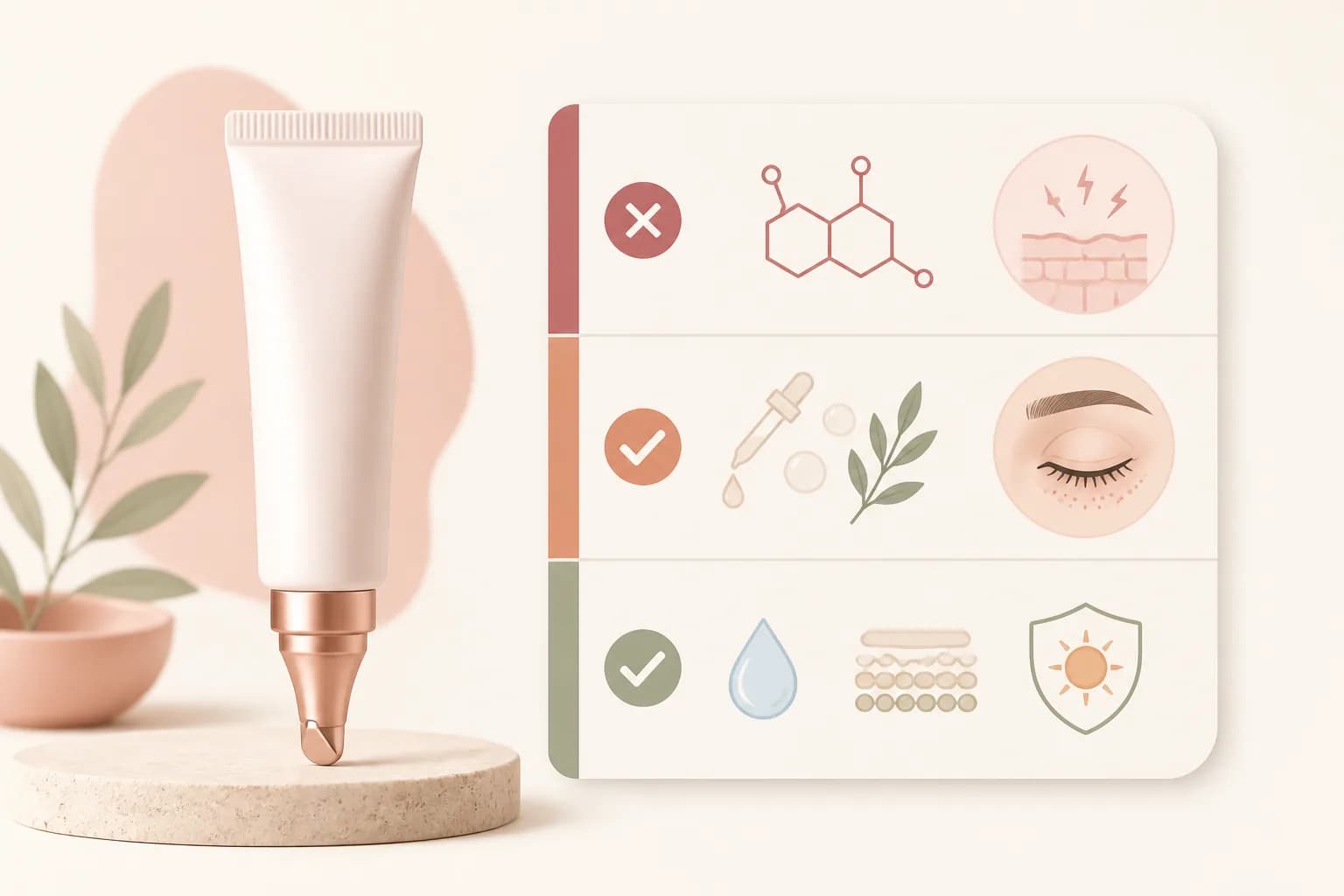
This visual is a decision aid, not a product certification. A green icon cannot make every formula suitable, and a long ingredient name is not evidence of danger.
The ingredients that change the answer
Retinoids: check more than the word retinol
Retinoids are common in anti-ageing eye creams. The AAD and ACOG recommend avoiding topical retinoids during pregnancy even though skin absorption is low. Read for retinol, retinal or retinaldehyde, retinyl palmitate and other retinyl esters, tretinoin, adapalene and tazarotene.
If you used a topical retinoid before you knew you were pregnant, stop it and contact your clinician for individual advice. That is a reason for a calm medication review—not a reason to assume harm.
Hydroquinone and dark-circle claims
The AAD also lists hydroquinone among ingredients to avoid during pregnancy. It can appear in pigment-fading treatments, though many cosmetic eye creams do not contain it. Dark circles can come from shadowing, visible vessels, pigment, allergies, sleep disruption or several factors at once, so a “brightening” promise does not identify the cause or guarantee a result.
Sun protection can help reduce pigment getting darker. Use a sunscreen that you tolerate around—not inside—the eyes, plus sunglasses and shade. A concealer is another reasonable non-treatment option.
Caffeine: useful claim, incomplete pregnancy evidence
Caffeine eye creams are marketed for temporary puffiness and dark circles. A pharmaceutical review confirms that topical caffeine can be delivered into and through skin, but it does not establish pregnancy safety or meaningful benefit for a specific cosmetic eye cream. Pregnancy-specific topical studies are limited.
That means “topical” is not the same as “zero absorption,” and eye cream is not the same exposure as a cup of coffee. It also does not mean caffeine eye cream is known to be harmful. If you want the lowest-uncertainty routine, choose a caffeine-free moisturising formula. If caffeine matters to you, show the exact product and use pattern to your obstetrician, pharmacist or dermatologist rather than adding the tube’s caffeine to dietary milligrams yourself.
Acids and acne actives: context matters
ACOG lists topical azelaic acid, benzoyl peroxide, salicylic acid and glycolic acid as OTC acne options that can be used during pregnancy. MotherToBaby notes that skin is a good barrier, while absorption can rise when skin is broken or irritated, over a larger area or with repeated use.
That guidance does not turn every strong peel into an eye treatment. Keep exfoliating acids away from the mobile eyelid and lash line unless the product specifically directs otherwise. Ask before using a prescription treatment or high-strength peel near the eyes.
What a simpler eye formula looks like
For dryness, start with humectants and barrier-supporting ingredients such as glycerin, hyaluronic acid, panthenol and ceramides. These do not promise to erase genetic or structural dark circles; they can help the skin feel less dry and look temporarily smoother.
A separate eye cream is optional. If your usual bland, fragrance-free facial moisturiser does not sting, the label fits your pregnancy plan and its directions allow facial use, a small amount around the orbital bone may do the same basic moisturising job.
Sensitive eyelids need an irritation check too
Eyelid skin is especially prone to contact reactions. DermNet lists eye creams, sunscreens, makeup, cleansers, fragrances and essential oils among possible triggers; even nail products can transfer from fingers to eyelids.
- Patch test a new product away from the eye first.
- Apply with clean hands and keep it out of the eye and off the lash line unless directed.
- Stop for persistent burning, itching, scaling or swelling.
- Seek urgent care for severe swelling, breathing trouble, eye pain or vision changes.
- See a clinician when a recurring eyelid rash does not settle; “sensitive skin” can hide contact dermatitis, blepharitis or another condition.
The practical decision
1. Photograph or copy the complete INCI list—not only the front label.
2. Rule out retinoids and hydroquinone.
3. Identify treatment actives such as caffeine, acids or prescription medicines.
4. Prefer a simple fragrance-free moisturising formula when your eyelids are reactive.
5. Check a specific uncertainty with your obstetrician, pharmacist or dermatologist.
This article provides general information and does not replace individual maternity, dermatology or eye-care advice.
Can I use eye cream while pregnant?
Many eye creams can fit a pregnancy routine, but “eye cream” is only a product category. Check the complete ingredient list, avoid retinoids and hydroquinone, and stop if the delicate eyelid area becomes irritated.
Is retinol eye cream safe during pregnancy?
No. AAD and ACOG recommend avoiding topical retinoids during pregnancy. Check for retinol, retinal or retinaldehyde, retinyl esters, tretinoin, adapalene and tazarotene.
Can I use caffeine eye cream during pregnancy?
Pregnancy-specific safety and effectiveness data for cosmetic caffeine eye creams are limited. Topical caffeine can cross the skin, so do not treat it as identical to drinking coffee. If you prefer the lowest-uncertainty option, choose a caffeine-free moisturising formula or ask your clinician about the exact product.
Do I need a separate eye cream during pregnancy?
Usually not. If your normal fragrance-free facial moisturiser does not sting and its label fits your pregnancy plan, a small amount around the orbital bone may be enough. Keep products out of the eye and follow the label directions.
References
Authoritative references used to score this ingredient.